---
title: "Events"
description: "Reference documentation for the Events endpoints in the Klaviyo REST API."
url: "https://developers.klaviyo.com/en/v2025-04-15/reference/events"
revision: "2025-04-15"
llmsTxt: "https://developers.klaviyo.com/en/v2025-04-15/reference/events/llms.txt"
---
# Events
## Before you begin
Check out our general [API overview](https://developers.klaviyo.com/en/reference.md) before getting started with specific endpoints.
> [!NOTE]
> Check out our YouTube tutorial on creating custom events with the Events API.
Our [Events API](https://developers.klaviyo.com/en/reference/get_events.md) allows you to retrieve and create events, which are actions taken by Klaviyo profiles. Each event has exactly one metric (effectively the “event type”) associated with it and a timestamp for when it occurred. The metric and profile associated with an event are stored in the event’s [relationships](https://developers.klaviyo.com/en/docs/relationships_.md) object. There are two types of endpoints within the Events API:
- Events endpoints for fetching or creating event data.
- Relationships endpoints for accessing a list of related metrics or profiles for a specific event.
## Use cases
The Events API supports the following use cases:
- Creating custom events that can be used to trigger flows (e.g., a _Reset Password_ event that triggers an email with a reset password URL).
- Getting Klaviyo events that can be used for data analysis (e.g., retrieving engagement events tracked by native Klaviyo metrics, such as _Opened Email_ and _Clicked SMS_).
- Getting a specific profile’s events to power an activity feed.
- Getting related profile and/or metric data for a given event.
You can find example code for all of these use cases in our [api-examples repo](https://github.com/klaviyo-labs/api-examples/tree/main/events).
> [!NOTE]
> **Analyze your marketing performance with the Reporting API**
> Use Klaviyo's Reporting API to request 1:1 matches of campaign, flow, form, or segment performance data shown in the Klaviyo app.
## Data model
An event can have the following:
- `properties` (required)
The properties of the event (see _Event properties_). Non-object properties can be used for creating segments. The `$extra` property records any non-segmentable values, e.g., HTML templates, that can be referenced later.
- `time `
The timestamp of when the event occurred. By default, the value is the time the event was created. You should provide `time` when creating a historical event for a profile.
- `value `
The numeric value to associate with the event, e.g., a price. Defaults to 0 if events logged under the provided metric have historically contained a `value` field.
- `unique_id `
A client-supplied unique identifier for an event. Used for idempotency: if you POST the same event twice with the same `unique_id` (same profile, same metric), only the first processed event is recorded — the duplicate is discarded. This makes the Create Event endpoints safe to retry. We recommend generating a UUID v4 per event (e.g., via the [`uuid`](https://www.npmjs.com/package/uuid) npm package or the built-in [`crypto.randomUUID()`](https://developer.mozilla.org/en-US/docs/Web/API/Crypto/randomUUID)) and sending the same value on retry.
> [!WARNING]
> **Use unique ID to avoid event loss**
> If you do not provide a `unique_id`, multiple events sent at the same time will be assigned the same default `unique_id` (the event timestamp truncated to the second) and may be removed as duplicates (see _Event deduplication behavior_).
- `backfill`
Optional boolean, defaults to `false`. When `true`, indicates the event is part of a historical / backfill sync. The event is still recorded and is visible in metrics, segmentation, and the events API, but it **does not trigger flows**. Use this when replaying events that have already fired in the past (e.g., a full sync from an external CRM) so existing flow definitions do not re-fire on those historical events and send duplicate messages. Available on both `Create Event` and `Bulk Create Events` — on bulk, set `backfill: true` at the top level of each `event-bulk-create` entry to apply it to every event in that entry.
- `relationships`
- `metric`
The metric associated with the event.
- `profile`
The profile associated with the event.
## Events and metrics
Each event object is related to a [metric](https://help.klaviyo.com/hc/en-us/articles/115005076787) object, per the data model above. A metric is what defines an event’s type. Think of a metric as a recipe name and its defined events as the instances in which the recipe was cooked. Each event includes the recipe name (`metric`), the chef (`profile`), the `time` the recipe was cooked, and details like ingredients (`properties`) and, optionally, `value`. When you create a custom event object via API, you’ll need to provide a metric `name` associated with the event, for example, _Viewed Product_. If the metric you provide does not match an existing one, a new metric will be created with its own `metric_id`. The `metric_id` connects the metric to an event. This ID, along with other fields like `profile_id,` can be used to query events.
## Event properties
Each event includes a `properties` object, which stores relevant details about the event being tracked. Some use cases of these properties include:
- **Segmentation**
Non-object property values can be used to build segments, e.g., a segment with customers who have purchased products within the "Skincare" category. See our [FAQ](https://developers.klaviyo.com/en/docs/custom_integration_faqs.md) for more information on how to structure event data for segmentation.
- **Flows**
Use data stored in event properties to personalize flows, e.g., build show/hide conditions in an abandoned cart flow based on a cart's value or items added.
- **Reporting**
Understand trends in reports by key event properties, e.g., create a report that gives performance data on revenue for Placed Order events for a specific product.
You may have up to 400 event properties per event. See _Limitations_ for information.
### Excluded property values
When setting event property values, it's important to know how Klaviyo handles certain inputs. The following values are ignored when used to update event properties:
- `0` (number data type)
- `null` or `None`
- `""` (empty string)
If you assign these values to event properties, Klaviyo treats them as if they were never set, i.e., the properties are excluded and cannot be used for segmentation.
Note that the way Klaviyo handles event properties differs from how it handles profile properties. You may create and segment of off profile properties with a value of `0`.
## Create Event
To create an event, you’ll need at least one [profile identifier](https://developers.klaviyo.com/en/reference/profiles.md) (e.g., `id`, `email`, or `phone_number`) and a metric `name`.
> [!WARNING]
> **Events using test emails are silently dropped**
> Creating an event using an `@example.com` , `@test.com` , or similar email address is accepted by the API and will return a 202. However, please note that events with these email addresses are silently dropped in the background and are stripped from the event pipeline.
Your request payload for [Create Event](https://developers.klaviyo.com/en/reference/create_event.md) should be formatted like the example _Reset Password_ event below:
```json Request payload
{
"data": {
"type": "event",
"attributes": {
"properties": {
"action": "Reset Password",
"PasswordResetLink": "https://www.website.com/reset/1234567890987654321"
},
"metric": {
"data": {
"type": "metric",
"attributes": {
"name": "Reset Password"
}
}
},
"profile": {
"data": {
"type": "profile",
"attributes": {
"email": "sarah.mason@klaviyo-demo.com"
}
}
},
"unique_id": "4b5d3f33-2e21-4c1c-b392-2dae2a74a2ed"
}
}
}
```
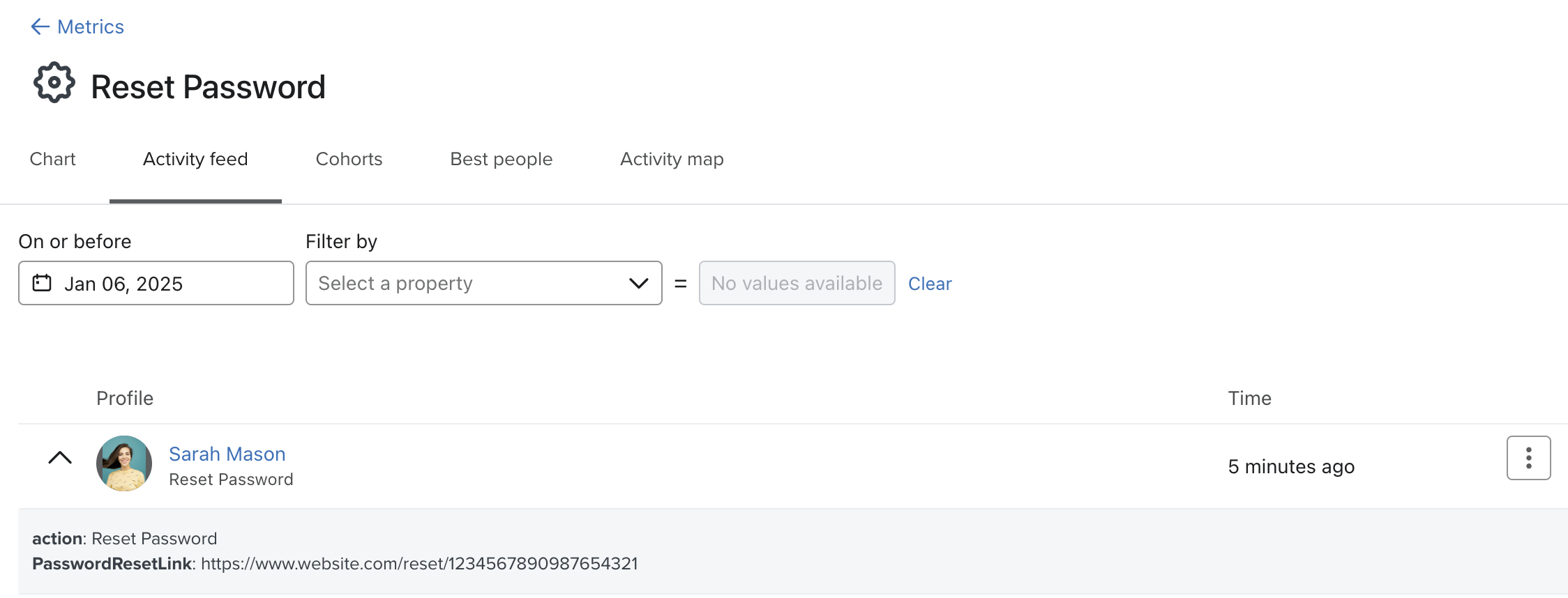
In the example Create Event payload, an `email`, `sarah.mason@klaviyo-demo.com`, and a metric `name`, _Reset Password_, are provided to associate the created event with a profile and a metric. The only optional field provided is the `unique_id` in UUID format for good practice. Once the event has been created, you should see the event logged in the profile’s activity feed in Klaviyo:
 ### Using optional fields like `time` and `value` in events
Use optional fields like `time` (for historical events) and/or `value` (e.g., price) to enrich your event data. _Ordered Product_ events are useful for creating flows based on product-specific information. They can also help with creating more personalized recommendations for your customers. In the example below, an _Ordered Product_ event is created with the `value `field representing the product’s price:
```json Request payload
{
"data": {
"type": "event",
"attributes": {
"properties": {
"OrderId": "cc50e5b3-059c-4f7d-9e26-821302b63235",
"ProductID": "1111",
"SKU": "WINNIEPOOH",
"ProductName": "Winnie the Pooh",
"Quantity": 1,
"ProductURL": "http://www.example.com/path/to/product",
"value": 9.99,
"metric": {
"data": {
"type": "metric",
"attributes": {
"name": "Ordered Product"
}
}
},
"profile": {
"data": {
"type": "profile",
"id": "01H7FZEVECGN0MNQ8V417TPVP0",
"attributes": {
"email": "sarah.mason@klaviyo-demo.com",
"phone_number": "+15005550006",
...
}
},
"unique_id": "cc50e5b3-059c-4f7d-9e26-821302b63235"
}
}
```
> [!WARNING]
> **Default behavior for missing `value` field**
> If events associated with a metric have previously been created with a `value` field, future events under the same metric will be created with a default `value` of `0`. Take the _Ordered Product_ event above, for example, which has a `value` of `9.99`. If another _Ordered Product_ event is created next, without a `value` field present in its request payload, you can expect its value field to be created and set to 0.
## Bulk Create Events
The [Bulk Create Events API](https://developers.klaviyo.com/en/reference/bulk_create_events.md) supports creating multiple events for one or more profiles at a time.
A maximum of 1,000 events can be created in a single request, and the max allowed payload size is 5MB.
### Bulk create events for a single profile
The example below is a request to [Bulk Create Events](https://developers.klaviyo.com/en/reference/bulk_create_events.md) to create 2 events (_Refunded Order_ and _Placed Order_) for a single profile:
```Text Request
{
"data": {
"type": "event-bulk-create-job",
"attributes": {
"events-bulk-create": {
"data": [
{
"type": "event-bulk-create",
"attributes": {
"profile": {
"data": {
"type": "profile",
"attributes": {
"email": "bill.joel@klaviyo-demo.com",
}
}
},
"events": {
"data": [
{
"type": "event",
"attributes": {
"properties": {
"Reason": "No longer needed.",
"Brand": "Kids Book",
"Categories": [
"Fiction",
"Children"
]
},
"time": "2024-05-10T00:00:00+00:00",
"value": 9.99,
"value_currency": "USD",
"unique_id": "3e57326a-f0b8-4d4f-98e5-aa56a39842d9",
"metric": {
"data": {
"type": "metric",
"attributes": {
"name": "Refunded Order"
}
}
}
}
},
{
"type": "event",
"attributes": {
"properties": {
"Brand": "Kids Book",
"Categories": [
"Fiction",
"Children"
]
},
"time": "2024-05-11T00:00:00+00:00",
"value": 9.99,
"value_currency": "USD",
"unique_id": "bd29b5e8-076f-405c-b34c-591794e196e6",
"metric": {
"data": {
"type": "metric",
"attributes": {
"name": "Placed Order"
}
}
}
}
}
]
}
}
}
]
}
}
}
}
```
> [!NOTE]
> **Keep profile properties up-to-date**
> You can create a new profile or update a profile's properties when creating an event via Events API. For bulk events, it’s important to ensure that any included profile properties are up-to-date.
### Bulk create events for multiple profiles
You can use Bulk Create Events for creating events for multiple profiles at a time. The request payload in the example below creates events for 2 different profiles:
```Text Request
{
"data": {
"type": "event-bulk-create-job",
"attributes": {
"events-bulk-create": {
"data": [
{
"type": "event-bulk-create",
"attributes": {
"profile": {
"data": {
"type": "profile",
"attributes": {
"email": "bill.joel@klaviyo-demo.com"
}
}
},
"events": {
"data": [
{
"type": "event",
"attributes": {
"properties": {
"Brand": "Kids Book",
"Categories": [
"Fiction",
"Children"
]
},
"time": "2023-05-08T00:00:00+00:00",
"value": 9.99,
"value_currency": "USD",
"unique_id": "baf5fcf1-8e41-4868-a9b0-3a3c63c805e8",
"metric": {
"data": {
"type": "metric",
"attributes": {
"name": "Placed Order"
}
}
}
}
}
]
}
}
},
{
"type": "event-bulk-create",
"attributes": {
"profile": {
"data": {
"type": "profile",
"attributes": {
"phone_number": "+13105555555"
}
}
},
"events": {
"data": [
{
"type": "event",
"attributes": {
"properties": {
"Brand": "Kids Book",
"Categories": [
"Fiction",
"Children"
]
},
"time": "2023-05-09T00:00:00+00:00",
"value": 9.99,
"value_currency": "USD",
"unique_id": "fc2ac97b-24dc-4c2c-8e8e-232834dd69a8",
"metric": {
"data": {
"type": "metric",
"attributes": {
"name": "Viewed Product"
}
}
}
}
}
]
}
}
}
]
}
}
}
}
```
## Event deduplication behavior
Both the Create Event and Bulk Create Events endpoints deduplicate on the tuple `(profile, metric, unique_id)`. This means you may receive a `202 Accepted` response upon creating events, but later find that some were considered duplicates and discarded. To ensure events are processed successfully, follow the best practices outlined below.
### Idempotency with `unique_id`
The `unique_id` field is the primary idempotency key for event ingestion. If two events are submitted with the same profile, the same metric, and the same `unique_id`, only the first processed event is recorded — the duplicate is silently discarded.
This makes event creation safe to retry. If a Create Event call fails with a network error or timeout, retrying with the same `unique_id` is a no-op if the original already landed, and will create the event if it did not. Without a `unique_id`, a retried request can create a second event.
**Best practice:** generate a stable `unique_id` (e.g., a `uuidv4`) per logical event at the source, and send the same value on every retry for that event. Bulk Create Events enforces `unique_id` uniqueness within a single request — repeated values within the same request return `400 Bad Request`, and no events in the request are processed.
If you do not provide `unique_id`, the server defaults it to the event timestamp truncated to the second. Two events for the same profile/metric that land in the same second will collide and one will be dropped.
### Include the `time` field for historical events
When importing historical events, always include the `time` field to specify when the event occurred. If `time` is omitted and you do not provide a `unique_id`, events default to "now" and events for the same profile/metric submitted within the same second will be deduplicated.
## Historical and backfill events
When you are replaying historical events that have already happened in the past — for example, a one-time sync of every `Placed Order` from your ecommerce platform, or re-running a bulk import after a data correction — any flow gated on those metrics will fire again and send messages to profiles who already received them. To suppress flow triggering for a historical replay, set `backfill: true` on the event.
```json Create Event with backfill
{
"data": {
"type": "event",
"attributes": {
"backfill": true,
"time": "2024-01-15T09:30:00Z",
"properties": {
"OrderId": "cc50e5b3-059c-4f7d-9e26-821302b63235",
"ProductName": "Winnie the Pooh",
"Quantity": 1,
"value": 9.99,
"value_currency": "USD"
},
"metric": {
"data": {
"type": "metric",
"attributes": {"name": "Placed Order"}
}
},
"profile": {
"data": {
"type": "profile",
"attributes": {"email": "sarah.mason@klaviyo-demo.com"}
}
},
"unique_id": "4b5d3f33-2e21-4c1c-b392-2dae2a74a2ed"
}
}
}
```
When `backfill: true`:
- The event is ingested normally and is visible in the events API, metrics, and segmentation.
- Flows that would otherwise trigger on the event's metric do **not** fire.
- Use `time` so the event is stored with its original timestamp, not "now".
For `Bulk Create Events`, set `backfill: true` at the top level of each `event-bulk-create` entry to apply it to every event in that entry — you do not need to repeat it on each event:
```json Bulk Create Events with backfill
{
"data": {
"type": "event-bulk-create-job",
"attributes": {
"events-bulk-create": {
"data": [
{
"type": "event-bulk-create",
"attributes": {
"backfill": true,
"profile": {
"data": {
"type": "profile",
"attributes": {"email": "bill.joel@klaviyo-demo.com"}
}
},
"events": {
"data": [
{
"type": "event",
"attributes": {
"properties": {
"Brand": "Kids Book",
"Categories": ["Fiction", "Children"]
},
"time": "2023-05-08T00:00:00+00:00",
"value": 9.99,
"value_currency": "USD",
"unique_id": "baf5fcf1-8e41-4868-a9b0-3a3c63c805e8",
"metric": {
"data": {
"type": "metric",
"attributes": {"name": "Placed Order"}
}
}
}
}
]
}
}
}
]
}
}
}
}
```
## Troubleshooting
If you're trying to create events via either of the APIs above, and your events are not showing up in Klaviyo, follow the troubleshooting tips below.
### Receiving a 400?
- Use a valid email address that is less than 100 characters. We recommend using [regex for email validation](https://emailregex.com/index.html).
- Use a valid E.164 phone number. If your request only contains an invalid phone number without a valid email address, it will be rejected. We recommend using a library like [libphonenumber](https://github.com/google/libphonenumber) to ensure numbers are valid and properly formatted prior to sending.
- Your payload must be in the format indicated by the API’s reference documentation.
### Receiving a 202?
Events are created asynchronously, so it may take up to a few minutes to see them in the UI or returned via the [Get Events API](https://developers.klaviyo.com/en/reference/get_events.md).
If you're still not seeing the events in Klaviyo, you may be sending a payload that:
- Contains email addresses using an "@example.com" or "@test.com" domain. Such email addresses may be silently dropped by our event pipeline during processing.
- Provides a non-unique `unique_id` that will result in duplicates for a given metric and profile.
- Creates multiple events for a metric and profile at once. [Duplicates will be ignored](https://developers.klaviyo.com/en/reference/events.md) if you're not using a `unique_id`.
- Contains an incorrect profile identifier. At least one profile identifier is needed to determine which profile triggered the event. Only include known identifiers when creating events.
> [!WARNING]
> **Limit profile identifiers to known values**
> Our API reference documentation lists all supported profile identifiers (`id`, `email`, `phone_number`, `external_id`), however, providing every identifier is unnecessary. If you're including a profile ID along with an email and/or phone number, it's possible that the ID is incorrect. To avoid this error, limit your provided identifiers to known values.
## Get Event(s)
When making a [Get Event](https://developers.klaviyo.com/en/reference/get_event.md) or [Get Events](https://developers.klaviyo.com/en/reference/get_events.md) request, here’s an example of how the _Reset Password_ event object from the example above might look in your response:
```curl Request
curl --request GET \
--url https://a.klaviyo.com/api/events/ \
--header 'Authorization: Klaviyo-API-Key your-private-api-key' \
--header 'accept: application/json' \
--header 'revision: 2023-10-15'
```
```json Response
{
"type": "event",
"id": "4KAmvjsbt9F",
"attributes": {
"timestamp": 1700241683,
"event_properties": {
"action": "Reset Password",
"$event_id": "4b5d3f33-2e21-4c1c-b392-2dae2a74a2ed"
},
"datetime": "2023-11-17 17:21:23+00:00",
"uuid": "bafaeb80-856d-11ee-8001-47fc5d8979c5"
},
"relationships": {
"profile": {
"data": {
"type": "profile",
"id": "01H7FZEVECGN0MNQ8V417TPVP0"
},
"links": {
"self": "https://a.klaviyo.com/api/events/4KAmvjsbt9F/relationships/profile/",
"related": "https://a.klaviyo.com/api/events/4KAmvjsbt9F/profile/"
}
},
"metric": {
"data": {
"type": "metric",
"id": "WvcZZE"
},
"links": {
"self": "https://a.klaviyo.com/api/events/4KAmvjsbt9F/relationships/metric/",
"related": "https://a.klaviyo.com/api/events/4KAmvjsbt9F/metric/"
}
}
},
"links": {
"self": "https://a.klaviyo.com/api/events/4KAmvjsbt9F/"
}
}
```
Note that there are `id` values for the `profile` and `metric` associated with the event in the `relationships` object. The following example is a call to [Get Profile](https://developers.klaviyo.com/en/reference/get_profile.md) using the profile `id` returned in the response:
```curl Request
curl --request GET \
--url https://a.klaviyo.com/api/profile/01H7FZEVECGN0MNQ8V417TPVP0/ \
--header 'Authorization: Klaviyo-API-Key your-private-api-key' \
--header 'accept: application/json' \
--header 'revision: 2023-10-15'
```
```json Response
{
"data": {
"type": "profile",
"id": "01H7FZEVECGN0MNQ8V417TPVP0",
"attributes": {
"email": "sarah.mason@klaviyo-demo.com",
"phone_number": null,
"external_id": null,
"anonymous_id": null,
"first_name": "Sarah",
"last_name": "Mason",
...
```
The response contains the profile object with the same identifier used to create the _Reset Password_ event, `sarah.mason@klaviyo-demo.com`.
The following example is a call to [Get Metric](https://developers.klaviyo.com/en/reference/get_metric.md) with the metric `id` value from the _Reset Password_ response:
```curl Request
curl --request GET \
--url https://a.klaviyo.com/api/metrics/WvcZZE/ \
--header 'Authorization: Klaviyo-API-Key your-private-api-key' \
--header 'accept: application/json' \
--header 'revision: 2023-10-15'
```
```json Response
{
"data": {
"type": "metric",
"id": "WvcZZE",
"attributes": {
"name": "Reset Password",
"created": "2023-10-31T18:42:12+00:00",
"updated": "2023-10-31T18:42:12+00:00",
"integration": {
"object": "integration",
"id": "7FtS4J",
"name": "API",
"category": "API"
}
},
"links": {
"self": "https://a.klaviyo.com/api/metrics/WvcZZE/"
}
}
}
```
The API-created metric object with the name _Reset Password_ is returned in the response.
## Querying events
Querying events with the Events API can help you achieve many use cases, such as populating a list with events that match a specific `profile_id`. Check out the supported query parameters below and [test them out with our latest Postman collection](https://developers.klaviyo.com/en/docs/use_klaviyos_postman_collections.md). Note that support for given operators and fields is endpoint-specific. Review the [API reference documentation](https://developers.klaviyo.com/en/reference/get_events.md) for more information on allowed fields and query operators.
| Parameter | Description | Query example |
| --- | --- | --- |
| `filter` | Retrieve a subset of events, e.g., events for a specific `profile_id` and/or `metric_id` Learn about the [filter query parameter](https://developers.klaviyo.com/en/docs/filtering_.md). | `GET /api/events?filter=and(equals(profile_id,"PROFILE_ID")
,equals(metric_id,"METRIC_ID")` |
| `sort` | Sort events, e.g., by `datetime` in ascending order (oldest to newest). Learn about the [sort query parameter](https://developers.klaviyo.com/en/docs/sorting_.md). | `GET /api/events?sort=datetime` |
| `fields` | Request for only specified event data, e.g., timestamp attributes. You can also request for only specified related resource data. Learn more about [sparse fieldsets](https://developers.klaviyo.com/en/docs/sparse_fieldsets.md). | `GET /api/events?fields[event]=timestamp`
`GET /api/events?include=profile&fields[profile]=email` |
| `include` | Include related resources in the response, e.g., profile data. Learn about the [include query parameter](https://developers.klaviyo.com/en/docs/relationships_.md). | `GET /api/events?include=profile` |
| `has` | Request for events that are related to existing profiles. This is useful for filtering out events that do not have any existing profile data (i.e., deleted profiles). | `GET /api/events?filter=has(profile)` |
### Query example
To filter events by profile ID `profile_id`, you can first use a [Get Profiles](https://developers.klaviyo.com/en/reference/get_profiles.md) query to obtain a profile’s `id` by email or phone number, like this call to [Get Events](https://developers.klaviyo.com/en/reference/get_events.md):
`GET /api/events?filter=equals(email,"sarah.mason@klaviyo-demo.com")`
The following example is a request to [Get Events](https://developers.klaviyo.com/en/reference/get_events.md) and uses the `id` value obtained from the [Get Profiles](https://developers.klaviyo.com/en/reference/get_profiles.md) query above as the `profile_id` to filter events:
```curl Request
curl --request GET \
--url 'https://a.klaviyo.com/api/events/?filter=equals(profile_id,"01H7FZEVECGN0MNQ8V417TPVP0")' \
--header 'Authorization: Klaviyo-API-Key your-private-api-key' \
--header 'accept: application/json' \
--header 'revision: 2023-10-15'
```
```json Response
{
"data": [
{
"type": "event",
"id": "4KAmvjsbt9F",
"attributes": {
"timestamp": 1700241683,
"event_properties": {
"Action": "Reset Password",
"$event_id": "4b5d3f33-2e21-4c1c-b392-2dae2a74a2ed"
},
"datetime": "2023-11-17 17:21:23+00:00",
"uuid": "bafaeb80-856d-11ee-8001-47fc5d8979c5"
},
"relationships": {
"profile": {
"data": {
"type": "profile",
"id": "01H7FZEVECGN0MNQ8V417TPVP0"
},
...
},
"metric": {
"data": {
"type": "metric",
"id": "WvcZZE"
},
...
}
},
"links": {
"self": "https://a.klaviyo.com/api/events/4KAmvjsbt9F/"
}
}
],
...
}
```
## Limitations
A set limit is allotted for each unique data identifier or digested piece of information. In most instances, if you reach the maximum data limit for a set category, the overflow information will not be processed and messages will be rejected. The following table provides the data limits for each event so you can ensure successful delivery and storage.
| Limitation type | Description | Limit
| ------------- |------------- |------------- |
| Max payload size (includes `$extra`) | Applies to custom event data; excludes profile data | 5 MB decompressed |
| Max number of event properties per event | The number of pieces of data within an event | 400 |
| Max string size | Any string value | 100 KB |
| Max number of items in arrays | Event data in a list format, see [understanding data types](https://help.klaviyo.com/hc/en-us/articles/115005237648) | 4000 |
| Max levels of nested objects | Any combination of objects and arrays within event properties; currently only applies to objects | 11 |
| Timestamp of events | The time an event occurred; learn more about [acceptable date and timestamp formats for profile and event properties](https://developers.klaviyo.com/en/docs/acceptable_date_and_timestamp_formats_for_profile_and_event_properties.md) | Between 1990 and “now”+1 year (e.g., if the current year is 2026, the max is 2027 and the minimum is 1990) |
| Field length for `$event_id` (`unique_id`) | Allowed characters for the unique identifier of an event | 1-255 characters |
| Max integers | Applies anywhere there's an integer | 64 bits (-9,223,372,036,854,775,808 & +9,223,372,036,854,775,807) |
| Max size of an event's profile object | Profile objects created or updated via Events API | 95 KB |
## Next steps
- Create an event in [Postman](https://www.postman.com/klaviyo) for an existing profile in your Klaviyo test account.
- Check for the created event under the specific profile’s activity feed in Klaviyo.
- Make a call to [Get Events](https://developers.klaviyo.com/en/reference/get_events.md) to retrieve your new event.
- Try out some of the query parameters above to customize your response.
## Additional resources
- [Set up API-based transactional events](https://developers.klaviyo.com/en/docs/guide_to_setting_up_api_based_transactional_events.md)
- [Integrate an ecommerce platform without a pre-built Klaviyo integration](https://developers.klaviyo.com/en/docs/guide_to_integrating_a_platform_without_a_pre_built_klaviyo_integration.md)
- [JSON:API feature guides](https://developers.klaviyo.com/en/docs/json_api_feature_guides.md)
## Bulk Export APIs overview (beta)
### Before you begin
Check out our [general API overview](https://developers.klaviyo.com/en/reference.md) before getting started with specific endpoints.
> [!WARNING]
> **Access required**
> The Bulk Export APIs are **invite-only during beta**. Access is limited to allow-listed API keys and OAuth applications, and is granted **selectively** — submitting a request does not guarantee access. To request access, submit [this form](https://forms.gle/bdLnik7HvuxFXwS96). Access is granted either at the **OAuth app level** (for approved partners building a multi-tenant integration across their install base) or at the **account level** (for a customer requesting access for their own account). During beta we review requests periodically and enable access at our discretion. We are evaluating a pricing model during this invite-only beta period and would welcome your feedback; eligibility, availability, and terms may change before GA.
> [!WARNING]
> These endpoints are in **Beta** and require the `revision: 2026-07-15.pre` header. Endpoint paths and request/response shapes may change before GA.
The Bulk Export APIs let approved partners and businesses export large volumes of historical **event** and **profile** data from Klaviyo through asynchronous jobs. Instead of paginating through the standard [Get Events](https://developers.klaviyo.com/en/reference/get_events.md) or [Get Profiles](https://developers.klaviyo.com/en/reference/get_profiles.md) endpoints, you create an export job, poll it until it completes, and download a single compressed file. This is designed for one-time backfills, migrations, and analytics loads — not for real-time, incremental syncs.
There are two APIs:
- **Events bulk export** — export events for a given metric within a date range. See [Create Event Bulk Export Job](https://developers.klaviyo.com/en/reference/create_event_bulk_export_job_beta.md).
- **Profiles bulk export** — export the profiles in a given list or segment. See [Create Profile Bulk Export Job](https://developers.klaviyo.com/en/reference/create_profile_bulk_export_job_beta.md).
### Use cases
The Bulk Export APIs support the following use cases:
- **Model training and enrichment**: pull a large, historical set of events or profiles to train predictive models or hydrate a feature store during onboarding, where the pattern is a lagging, ad-hoc load rather than continuous real-time ingestion.
- **Historical backfill**: seed a data warehouse or lake with a full history of a metric's events, or a full membership snapshot of a list or segment.
- **Migration and audit**: export a segment's profiles for a one-time migration, reconciliation, or compliance audit.
### Required scopes
Access is gated separately from scopes (see the access callout above), but your API key or OAuth app still needs the appropriate read scopes for the data you're exporting:
- **Events bulk export**: `events:read` and `metrics:read`
- **Profiles bulk export**: `profiles:read`, `lists:read`, and `segments:read`
### How bulk export works
Bulk export is a three-step, asynchronous flow:
1. **Create a job.** `POST` to the relevant create endpoint with your export parameters. A successful request returns `202 Accepted` with a job `id`. The export runs in the background.
2. **Poll for status.** Retrieve the job by its `id` to check its status. When the job is `complete`, the response includes the file's expiration and size.
3. **Download the file.** Once complete, request the job's `download` to receive the exported data as a compressed CSV. Download URLs are short-lived — retrieve and download promptly, and create a new job if the file has expired.
#### Example: create an event bulk export job
```curl Request
curl --request POST \
--url 'https://a.klaviyo.com/api/event-bulk-export-jobs' \
--header 'Authorization: Klaviyo-API-Key your-private-api-key' \
--header 'accept: application/json' \
--header 'content-type: application/json' \
--header 'revision: 2026-07-15.pre' \
--data '
{
"data": {
"type": "event-bulk-export-job",
"attributes": {
"start_date": "2026-01-01T00:00:00Z",
"end_date": "2026-06-30T23:59:59Z"
},
"relationships": {
"metric": {
"data": {
"type": "metric",
"id": "WsRuHm"
}
}
}
}
}
'
```
#### Example: create a profile bulk export job
```curl Request
curl --request POST \
--url 'https://a.klaviyo.com/api/profile-bulk-export-jobs' \
--header 'Authorization: Klaviyo-API-Key your-private-api-key' \
--header 'accept: application/json' \
--header 'content-type: application/json' \
--header 'revision: 2026-07-15.pre' \
--data '
{
"data": {
"type": "profile-bulk-export-job",
"attributes": {},
"relationships": {
"segment": {
"data": {
"type": "segment",
"id": "01H2XYZABCDEFGHJKMNPQRSTVW"
}
}
}
}
}
'
```
For a profile export, provide **either** a `list` **or** a `segment` relationship — not both.
### Limitations
- **Beta and invite-only.** These endpoints require the `revision: 2026-07-15.pre` header and are only callable by allow-listed API keys and OAuth applications. Non-allow-listed callers receive a `403`.
- **Historical, not real-time.** Bulk export is built for large, ad-hoc loads. For ongoing, incremental data sync, use the standard [Events](https://developers.klaviyo.com/en/reference/get_events.md) and [Profiles](https://developers.klaviyo.com/en/reference/get_profiles.md) endpoints or [webhooks](https://developers.klaviyo.com/en/reference/webhooks.md).
- **Download URLs expire.** Completed export files are available for a limited time; create a new job if a file has expired.
- **Profile exports are scoped to one group.** Each profile export job targets a single list or segment.
### Additional resources
- [Create Event Bulk Export Job](https://developers.klaviyo.com/en/reference/create_event_bulk_export_job_beta.md)
- [Create Profile Bulk Export Job](https://developers.klaviyo.com/en/reference/create_profile_bulk_export_job_beta.md)
- [Set up OAuth](https://developers.klaviyo.com/en/docs/set_up_oauth.md)
- [Rate limits, status codes, and errors](https://developers.klaviyo.com/en/docs/rate_limits_and_error_handling.md)
## Endpoints
- [Get Events](https://developers.klaviyo.com/en/v2025-04-15/reference/get_events.md): `GET /api/events`
- [Get Event](https://developers.klaviyo.com/en/v2025-04-15/reference/get_event.md): `GET /api/events/{id}`
- [Create Event](https://developers.klaviyo.com/en/v2025-04-15/reference/create_event.md): `POST /api/events`
- [Bulk Create Events](https://developers.klaviyo.com/en/v2025-04-15/reference/bulk_create_events.md): `POST /api/event-bulk-create-jobs`
- [Get Metric for Event](https://developers.klaviyo.com/en/v2025-04-15/reference/get_metric_for_event.md): `GET /api/events/{id}/metric`
- [Get Metric ID for Event](https://developers.klaviyo.com/en/v2025-04-15/reference/get_metric_id_for_event.md): `GET /api/events/{id}/relationships/metric`
- [Get Profile for Event](https://developers.klaviyo.com/en/v2025-04-15/reference/get_profile_for_event.md): `GET /api/events/{id}/profile`
- [Get Profile ID for Event](https://developers.klaviyo.com/en/v2025-04-15/reference/get_profile_id_for_event.md): `GET /api/events/{id}/relationships/profile`